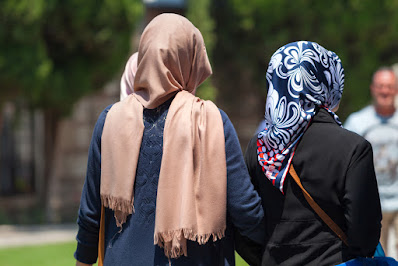
Being a Muslim Woman, how must they wear their attire to say that she is a Muslim woman?

Muslim Dress


Scholars have specified the requirements of the Muslim woman's proper dress before al-ajaanib (lit. foreigners, i.e., those to whom marriage is permissible) from both the Glorious Qur'an and the sunnah. Once a woman adheres to such conditions, she can wear whatever she likes and go out into public places so far as her hijab complies with Islamic law. A summary of the requirements are as follows:

  1. 1: It should cover the whole body.
  1. 2: It should be thick enough, i.e. non-transparent or translucent.
  1. 3: It should be loose and not tight on her body.
  1. 4: It should not be decorated or ornate such as to attract onlookers.
  1. 5: It should not be perfumed.
  1. 6: It should not be considered libaas al-shuhrah.
  1. 7: It should not resemble the dress of men.
  1. 8: It should not resemble the dress of the unbelievers.
  1. 9: It should not bear crosses or depictions of anything with a soul (humans, animals, etc).

This is a summary of the requirements according to the Islamic shari'ah.

Comments

Post a Comment

Popular posts from this blog

Want to Get admission in Islamic University of Madinah?

About the University: The Islamic University is a Saudi Arabian government university, under the supervision of the Ministry of Higher Education in Saudi Arabia. It was founded in 1381 A.H, and is a global Islamic institution in terms of its goals, as well as being Saudi Arabian in terms of its establishment. The University currently has five faculties: 1. Faculty of Islamic Law (Sharee’ah). It specialises in the subject of Islamic jurisprudence and its principles, and in teaching Islamic studies, as well as various supporting sciences. The faculty includes the following departments: A- Department of Jurisprudence (Fiqh). B- Department of the Principles of Jurisprudence (Usool ul Fiqh). C- Department of Judging and Islamic Politics. D- Department of Law The faculty offers a bachelor’s degree in Islamic law, and a higher diploma in judging and Islamic politics, as well as a master’s degree and a doctorate in its various fields of specialization. 2. Faculty of Islamic Preaching (Da...

Is Islamic slaughtering cruel to animals?

Islam's stance on what is permissible to eat and what is not is clear. There are strict rules when it comes to meat regarding what is allowed and what is forbidden. In Surat Al-Maida (The Table) Allah says: "Forbidden to you (for food) are: AI-Maytatah (the dead animals -cattle-beasts not slaughtered), blood, the flesh of swine, and the meat of that which has been slaughtered as a sacrifice for others than Allah or has been slaughtered for idols etc, or on which Allah's Name has not been mentioned while slaughtering and that which has been killed by strangling or by a violent blow or by a headlong fall or by the goring of horns - and that which has been (partly) eaten by a wild animal - unless you are able to slaughter it(before its death) and that which is sacrificed (slaughtered) on AnNusub (stone altars). [Forbidden] also is to use arrows seeking luck or decision, [all] that is Fisqun (disobedience of Allah and sin). This day, those who disbelieved have given up all...

RIGHTs and DUTIEs of HUSBAND and WIFE

  Islam has enjoined upon the husband's duties towards his wife, and vice versa, and among these duties are some which are shared by both husband and wife.  We will mention – by the help of Allaah – some of the texts of the Qur'an and Sunnah which have to do with the duties of the spouses towards one another, quoting also from the commentaries and views of the scholars.  Firstly:  The rights of the wife which are hers alone:  The wife has financial rights over her husband, which are the mahr (dowry), spending, and accommodation.  And she has non-financial rights, such as the fair division between co-wives, being treated in a decent and reasonable manner, and not being treated in a harmful way by her husband.  1.Financial rights  (a)The mahr (dowry). This is the money to which the wife is entitled from her husband when the marriage contract is completed or when the marriage is consummated. It is a right which the man is obliged to pay to the woman....